

Solidarity of the Fragile: The Antidote to Enmity
By Safwan Masri, Dean of GU-Q
There is an ancient scene that captures how human frailty can dissolve enmity in an instant. In The Iliad, after years of brutal war, Achilles—the embittered warrior who has lost his dearest friend—meets Priam, the aged father of his fallen enemy. The king kneels before him, begging for his son’s body, and implores Achilles to remember his own father’s mortality. Overcome by the memory of love and loss, as Homer writes, “both men gave way to grief… Priam wept for man-killing Hector… as Achilles wept himself, now for his father, now for Patroclus … and their sobbing rose and fell.”
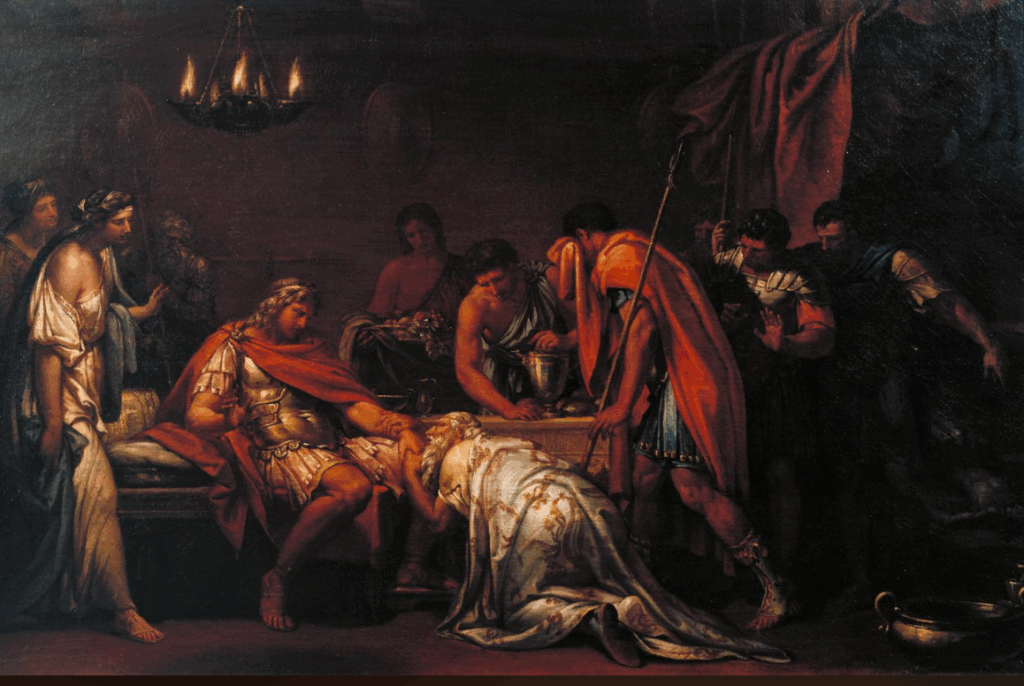
Priam Pleading with Achilles for the Body of Hector, 1775, Gavin Hamilton
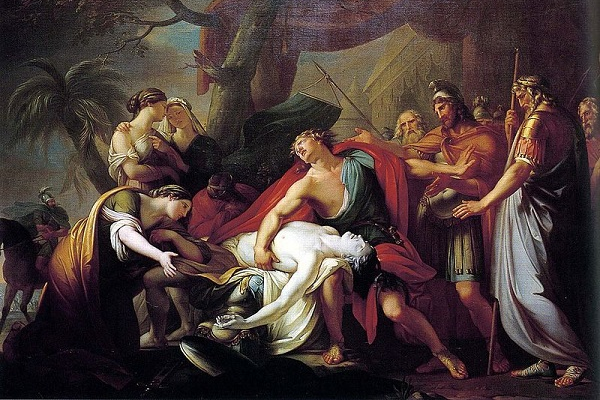
Achilles Lamenting the Death of Patroclus, 1760, Gavin Hamilton
In that moment, the fiercest Greek hero and the bereaved Trojan patriarch recognize each other’s pain and humanity. The story endures because it reveals something elemental: even in the aftermath of violence, the acknowledgment of shared fragility can restore empathy. If Achilles and Priam could glimpse solidarity through sorrow, might we—amid a less literal war—find it through our own shared vulnerabilities?
The first day of the Georgetown Global Dialogues explored political fragmentation and the rise of radical individualism. This is the paradoxical age we live in: we are more connected than ever through technology, yet more divided than ever by tribalism, polarization, and solitude.
Nations pull inward, communities fracture along partisan and sectarian lines, and an ideology of self-sufficiency erodes our sense of belonging. The result is not only political division but spiritual estrangement—a world where isolation masquerades as autonomy.
Yet acknowledging interdependence requires what the philosopher Iris Murdoch called “the extremely difficult realization that something other than oneself is real.” Her insight is both moral and imaginative: art and ethics share a single foundation … the ability to perceive beyond the self. If our age is marked by self-absorption, then nurturing that capacity for “unselfing” becomes a radical act. It breaks the spell of isolation. It reminds us that the person across the border, or across the aisle, is as real—and as breakable—as we are.
The second day of dialogue turned to a darker symptom of this fragmentation: rising cruelty—a creeping social Darwinism that glorifies strength and mocks compassion. We see it in rhetoric that dehumanizes migrants and minorities, in policies that punish the poor, and in wars and genocides where civilian suffering is treated as collateral.
The Cameroonian philosopher Achille Mbembe, reflecting on the intertwined crises of our age, issued a call both simple and profound: a universal right to breathe. In a world where some are suffocated by neglect, the right to breathe becomes a declaration that every life is sacred. Against the merciless arithmetic that prizes the strong and abandons the weak, Mbembe’s call reminds us that dignity, like air, must be indivisible.
To honor that right in deed as well as in word, we must cultivate imaginative sympathy at every level of society. Education and dialogue—the very purpose of gatherings like this—make such cultivation possible. The humanities, at their best, draw us out of ourselves. To read deeply, to listen fully, is to be briefly freed from the prison of ego.
At Georgetown University in Qatar, that practice takes living form. Our community draws from intellectual lineages that span continents: the poetic introspection of Arabic literature, the moral reasoning of Persian thought, the postcolonial imagination of Africa, and the philosophical rigor of South Asia.
Together, they sustain an ongoing dialogue about justice, power, and faith. This exchange defines who we are: a university where the global and the local meet and interrogate each other. Through this continuous encounter, we learn that scholarship becomes transformative when it carries the texture of the world it seeks to understand.
From this vantage point, GU-Q is honored to be a supporting partner of these Global Dialogues, which unite critical thought with moral imagination. And we look forward to hosting them in Doha next spring.
Recent years have made our fragility unmistakably global, as seen in a virus that crossed every border and a climate crisis that recognizes none. As our vulnerabilities are intertwined, so too must our solidarities be.
The choice before us is stark: retreat into silos of “each against all,” or build a future of “each for all.” The latter demands that we believe care can extend beyond kin and kind … and that empathy can be scaled.
This, then, is the solidarity of the fragile. In an age of extensive dialogue, such as those that unfolded in Barcelona, I urge us to remember that thinking is only half our task … the other is to begin remaking the world anew. If each of us leaves gatherings such as this carrying even one spark of another’s insight, one renewed sense of care … we will have kindled the slow, redemptive work of building a common future.
Speech delivered as the introduction to Georgetown Global Dialogues in Barcelona, Spain, November 4, 2025