

Georgetown SFS-Q And CCAS In Beijing Dialogue On China And The Middle East
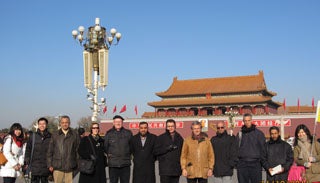
Dean Gerd Nonneman and Professor Mohamed Zayani of SFS-Q recently returned to Doha after presenting papers, along with colleagues from Georgetown University’s Center for Contemporary Arab Studies (CCAS) in Washington, DC. The joint effort by Peking University and Georgetown University on “China and the Arab World” was also attended by CCAS Director Osama Abi-Mershed and MAAS Director Judith Tucker along with CCAS professors Rochelle Davis, Jean-François Seznec, and Noureddine Jebnoun. This event was the first of its kind and spanned three days of activities, workshops, plenaries, and scholarly presentations. As an exploratory initiative, it was a great success, allowing Georgetown scholars to discover the high level of scholarship and work being undertaken under the auspices of Professors Fu Zhi-ming and Wu Bing Bing at Peking University’s Department of Arabic Language and Culture . The quality of Arabic studies and Middle East studies at Peking University bodes well for the next phase of Georgetown University’s China strategy, begun with a liaison office at Fudan University in Shanghai and continuing into the future.
Praising the level of scholarship, Dean Nonneman also remarked on the impressive command of Arabic displayed by Chinese graduate students present at the conference. “It was a very substantive conference. The papers and discussions were excellent. Peking University is very keen to build on this, as are we at SFS-Q and CCAS, potentially moving towards an annual joint conference alternating between Washington, Doha and Beijing,” he added.
As part of a number of emerging power blocks, both China and the Gulf Council Cooperation (GCC) share certain congruent economic and political opportunities, potentialities and evolving roles and aspirations. Since 2007, Georgetown has maintained a liaison office in China as a permanent bridge between the two academic communities, in order to share and learn from the scholarly work being undertaken there. Dean Nonneman’s own paper was entitled: “GCC Foreign Policy Patterns and the Relationship with China and the US”. He discussed the evolution in policy position of the GCC states in relation to domestic, regional and global changes. In particular, he elaborated on the meaning of these changes for the GCC’s relationship with China and the US. Professor Zayani’s paper was entitled: “Media and the Politics of Everyday Life” and dealt with the role social and new media played in the Arab Spring. In particular, he explained the manner in which control over information, the hallmark of authoritarian Arab regimes, helped to politicize young people, who found in the Internet a means to reclaim their political and citizenship rights.
“Aside from the academic merit of the conference, being in Beijing was a unique opportunity for me to see first-hand how China is positioning itself for the future,” commented Professor Zayani.
Other papers by scholars from CCAS at Georgetown in Washington, Peking University, and several other institutions in China, ranged from Arabic language teaching and Palestinian poetry to Gulf security and the economics of the GCC states.
This event re-affirmed the growing role that specialized Georgetown centers of learning are adopting, in relation to each other and in collaboration with external institutions such as Peking University. SFSQ intends to pursue and develop these networks in the future, along with CCAS and other Georgetown educational units in Italy, Turkey and China, in order to deepen and extend understandings of the Middle East, and the GCC in particular, in relation to these increasingly important political and economic regions.
Founded in 1789, Georgetown University is the oldest Catholic and Jesuit University in the United States. Today, it is a major student-centered, international, research university offering respected undergraduate, graduate and professional programs in Washington D.C., Doha and across the world. The establishment of the Qatar campus in 2005 continues a long history of engagement in the Middle East.Since 1919, the Edmund A. Walsh School of Foreign Service at Georgetown University has devoted itself to educating the next generation of diplomats, global leaders and scholars. At the Doha campus, students have the opportunity to major in International Economics (IECO), International Politics (IPOL) or Culture and Politics (CULP).