

Georgetown University in Qatar Hosts a Roundtable Discussion on Skills Training and Vocational Education in Qatar
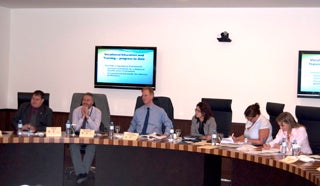
Employers, policy-makers & vocational education professionals emphasize importance of technical skills development
Georgetown University School of Foreign Service in Qatar in collaboration with Qatar Skills Academy (QSA), hosted a roundtable discussion on technical education and vocational training, for employers, policy-makers, stakeholders and vocational education professionals.
The aim of the session, which brought together industry leaders, government and education representatives, was to discuss ideas and develop specific actions addressing the targets described in Qatar’s National Development Strategy (NDS). One of the pillars of this strategy is to significantly develop technical education and vocational training to contribute to the various growing industries in the country.
“This session is of a great importance because it discussed topics that are important to developing and advancing education in the country, one of which is vocational training that is considered crucial to the development and implementation of Qatar’s NDS,” said Ahmadou Ahmad, Associate Expert at the General Secretariat for Development Planning.
“This is a great opportunity for both the GSDP and SFS-Qatar to develop points of interests between the two organizations and to increase the amount of cooperation between parties who are interested in this field, while exchanging ideas and opinions between them. This will definitely serve the Qatari society and support the country’s growth and development,” he added.
Moderated by Ian White, Director of QSA, the roundtable discussion titled “Skills training and vocational education in Qatar”, took place at the university’s Center for International and Regional Studies and was attended by high officials and experts representing prominent academic institutions and organizations including: Ministry of Labor, Qatar Museums Authority, Qatar University, Q-Tel, Rand Qatar Policy Institute and Commercial Bank.
“Skills training and development is a core requirement to building Qatar’s capacity as the economy continues to grow,” said Georgetown representative Charles Nailen. “Georgetown is pleased to be able to bring together representatives across all sectors to have a real conversation on how we all can help to achieve Qatar’s National Development Strategy.”
Speaking on the importance of these sessions was Dr. Hend Al Muftah, Assistant Professor at Qatar University: “Any project starts with an idea, which gets discussed by experts in sessions such as this one. This session brought together leaders, educators and stakeholders in the academic field, who discussed vocational education and training so that this specific topic is taken further and developed at a later stage.”
Ian White, Director of QSA, explained that Qatar’s NDS 2011-2016 stresses the importance of upgrading and deepening the education knowledge and skills of Qataris, in order to help transform Qatar into a diversified knowledge-economy with increased private sector participation.“One of the great things about this event is that it does not take pre-existing knowledge for granted. It requires a roundtable discussion event like this supported by partners, such as Georgetown SFS-Q and the GSDP, among other organizations to make sure they have a common understanding on where we are with this issue.”“It is through this discussion that we can take things further, put a formal plan in place, then start implementing this plan,” said White, who has previous experience in developing the mechanisms for the supply and demand of vocational training in developing economies.The roundtable took an in-depth look at technical and vocational training, as well as learning by doing and the vital role these play in creating employment opportunities for Qatari nationals. Moreover, the participants agreed on the establishment of a community of interest, start work on developing pilot and demonstration projects, and made commitment to explore a larger-scale conference in 2012, which will further develop the themes of the roundtable and provide a platform for sharing best practice from Qatar, the GCC and worldwide.