

Lawrence Potter Discusses Rise and Fall of Gulf Port Cities at Georgetown SFS-Q
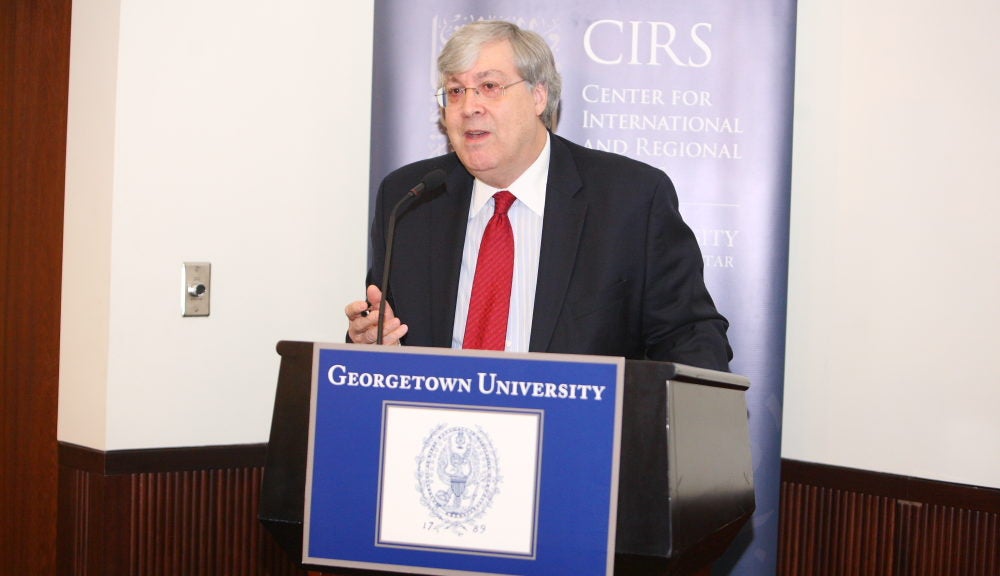
The Center for International and Regional Studies (CIRS) at Georgetown University’s School of Foreign Service in Qatar (SFS-Q) welcomed visiting historian Lawrence Potter to lecture at the most recent Monthly Dialogue session.
The lecturer, a 2011-2012 CIRS Visiting Scholar and Adjunct Associate Professor of International Affairs at Columbia University who specializes in Iranian history, titled his discussion, “The Rise and Fall of the Port Cities in the Gulf.”
Leading the dialogue, the historian discussed the economic, political and ecological reasons that might have caused the Gulf ports to either flourish or decline. Potter stated that in earlier centuries, during the medieval period, the important trading ports tended to be on the northern Persian shores of the Gulf; however, in the 19th and 20th centuries, there was a marked shift, and the southern Arab ports rose to prominence. Potter explained that due to these constant fluctuations in location, many only had a brief period of ascendancy.
The scholar discussed the possible reasons behind the rise and fall of the port cities, stating that they have always been strongly affected by their geographical setting. The harsh environment, as well as constant lack of water and wood, resulted in a number of settling problems. Furthermore, a port was readily abandoned if it silted up, Sharjah being a prime example of this phenomenon: “In the 20th century, this happened to Sharjah when the creek silted up, and trade shifted to Dubai. Dubai had the foresight to dredge the creek out in the 50’s and, of course, has since been a runaway success.”
The historian summarized his lecture by stating that there was an interchangeability of ports within the region, and that, within the Gulf, the fall of one port has always led to the rise of another. Potter finally concluded by stating that the locations of the ports were insignificant as the Gulf was effectively one market.
The discussion led to a lengthy question and answer period which prompted the historian’s insight into the future trajectory of the Gulf ports, stating that whilst it is impossible to predict the future, the ports within the region are delicately balanced at the present.
Mehran Kamrava, Director of CIRS at SFS-Q stated: “We are extremely honored to welcome Lawrence Potter to the university. He captivated and enlightened the audience, providing detailed insights into a very relevant subject.”
Georgetown’s Center for International and Regional Studies in Qatar is a premier research institute devoted to the academic study of regional and international issues. CIRS sponsors a number of forums throughout the year facilitating dialogue and an exchange of ideas on a broad range of issues with the aim to engage and enrich the university students and community.