

SFS-Q’s Culture and Politics Department Gathers International Scholars for Interdisciplinary Look at the Problem of Evil
The Culture and Politics (CULP) department of Georgetown University School of Foreign Service in Qatar hosted its first international, inter-disciplinary conference specifically addressing the archetypal ‘Problem of Evil: Literature, Politics, Ethics and Comparative Religion.’ Organized by SFS-Q Professors Patricia Reynaud and Jeremy Koons of the CULP department, and Dr. Aurélie Renault and Professor Inês Oseki-Depré of Aix en Provence, the event attracted internationally recognized scholars of various disciplines from Japan, France, Turkey, Morocco, Tunisia, Algeria, Swaziland and Canada.
The conference was bilingual, with sessions held in both English and French, and sought to explore the complex and multi-layered problem of evil as it relates to human beings as individuals. According to the conference organizers, “evil should be considered from the perspective of the individual: we are all torn between bad inclinations, categorically deemed harmful by morality, justice and religions, and good or worthy inclinations.”
Georgetown University Professors Amira El-Zein, Amira Sonbol, Ori Soltès, Mohanalakshmi Rajakumar and Patrick Laude gave presentations on diverse topics to an audience of experts, colleagues and interested guests.
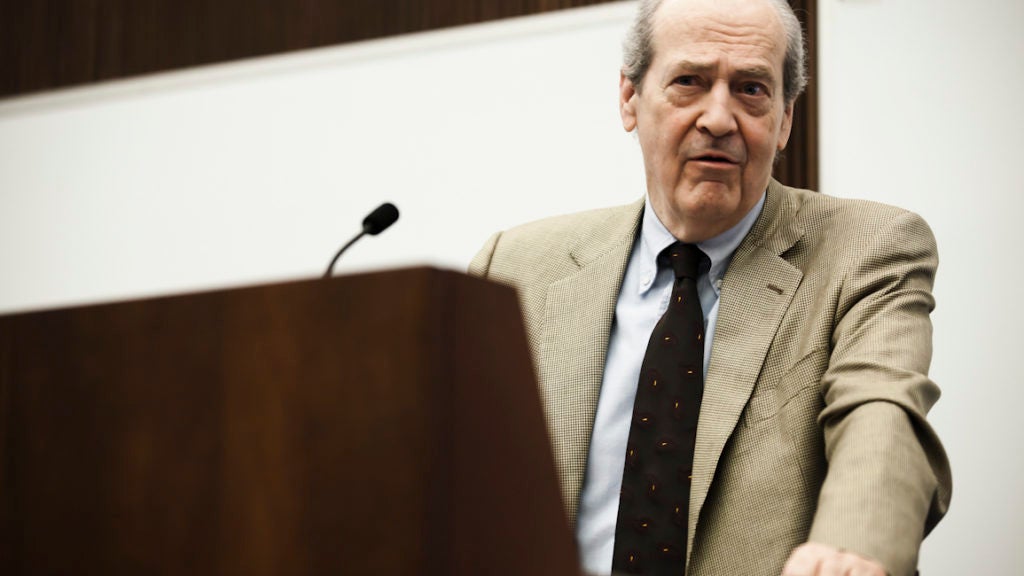
The keynote address of the conference was delivered by François Bizot, an expert in ethnology based in France. Born in 1940, his memoir The Gate, published in English in 2003, chronicles his extensive experience in Cambodia, where he was taken captive by the Khmer Rouge in 1971. More recently, Mr. Bizot published Le silence du bourreau (the English translation Facing the Torturer is due out shortly), a book which re-examines the problem of the ordinary man so dear to Hannah Arendt, in the context of the paradoxically humane treatment he had received at the hands of the Cambodian executioner, Comrade Duch.
Bizot explained how he came face-to-face with this notorious torturer of the Khmer Rouge regime, who personally signed the death warrants of more than 10 000 people. However, when Bizot was accused by the Khmer Rouge of being a CIA agent and subsequently imprisoned in cell-block M13, Comrade Duch, one of the main directors of the prison camp, demanded that Bizot be released. In this moment, Duch showed himself to be capable of humane sentiment. For Bizot, this demanded further reflection, and was the perfect entry-point for discussants into the problem of evil.Professor Jeremy Koons of SFS-Q concluded that, “it was a big CULP event; Patricia Reynaud put a lot of time and effort into it. It was a great opportunity for SFS-Q to bring in scholars from around the world and to sponsor a first-class, world-wide scholarly event.”