

Why Writing at Georgetown Is About Growth
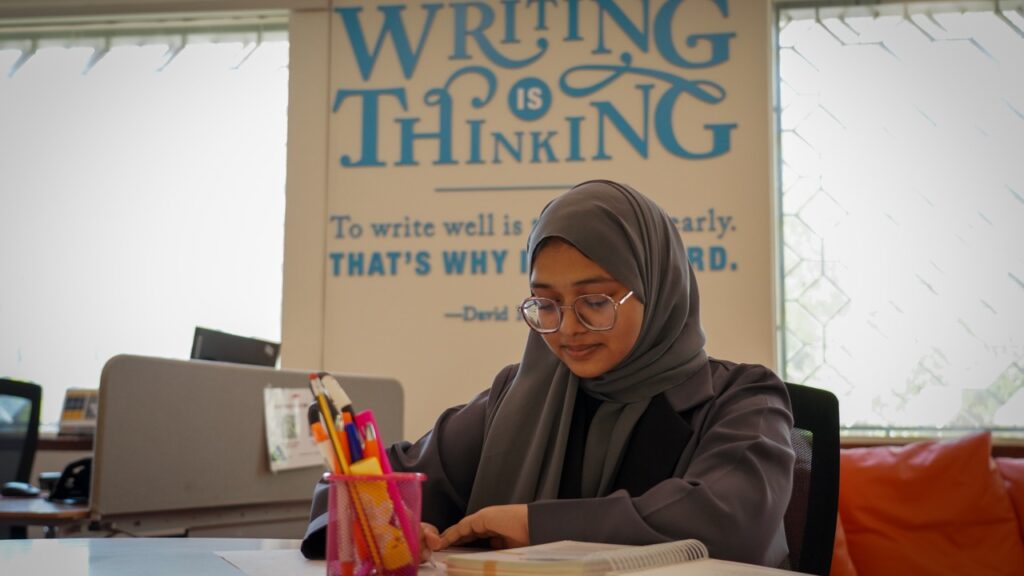
By Tahaniah Mohammed (GU-Q’28)
Tahaniah Mohammed is a second-year student majoring in International Politics
On the first day of WRIT 1165: Writing the Human Experience, Professor Rudd walked into our classroom and said something I never expected to hear at Georgetown: “Everyone in this room starts with an A!”.
Before I explain why my Professor said this, I should explain one of the requirements of this class. WRIT 1165 is a course that fulfills the Humanities, Art, Literature, and Culture requirement (HALC). Every Hoya at GU-Q has to take a HALC course to graduate, but this specific HALC course wasn’t a check-box requirement. This course was designed to help explore what it means to be human through different lenses.
This particular HALC course used a Labor-Based Grading contract. The professor explained that by taking the stress of traditional grading off the table, we were finally free to do something: focus entirely on the labor of learning and the messy process of being human.
The theme for our course was ‘On Othering & Belonging’. This course wasn’t about just fixing grammar or one of the rigorous writing courses you might have heard of. We were asking deep questions about how writers imagine or critique the human experience. One of my favorite assignments was the very first project called ‘My Perpetual World’. Without the fear of losing points for not sounding academic enough, we were asked to use creative designs and strategies like making a pie chart or drawing any form of representation of the factors to describe our own perceptual world.
Our class was also designated as an Engelhard Course. This is a unique Georgetown program where faculty link academic content to health and well-being. The labor-based grading wasn’t just a policy. It was an act of cura personalis, or care of the person, intended to increase our sense of well-being.
But what really makes this class special is that you don’t just write for a grade—you write for an audience. We were required to create our own individual blogs. It allowed us to write openly, share our exercises, and truly own our voices. Many of my colleagues from the class went on to publish their piece in GU-Q’s new anthology called Aswatna: Our Voices. See some highlights from the book launch.
In fact, the very blog you are reading right now is a result of the confidence I gained in WRIT 1165. It taught me that my voice, as a Hoya in the heart of the Middle East, has a place in the global conversation. Now, when I face a difficult research paper, I think about that first day of class and remind myself: the goal isn’t just to be ‘correct’, it is to be impactful.