

Students Develop Professional Case Studies For Teaching Religious Diversity
A pioneering collaboration between Education City universities has resulted in a groundbreaking initiative now transforming how religious pluralism is taught and understood globally. What began as an undergraduate course at Georgetown University in Qatar (GU-Q)—supported by a Qatar Foundation Multiversity Teaching Grant—has resulted in a publicly-accessible case study resource that is advancing the global study of interreligious dialogue.
“Teaching interfaith relations requires contextually sensitive pedagogical methods that account for local conditions, sensitivities, and the specific ways religious communities relate to one another in different societies,” says project lead Dr. Josef Meri, former professor at GU-Q and now senior fellow and research affiliate at Alwaleed Bin Talal Center for Muslim–Christian Understanding (ACMCU) at Georgetown University.
Previously, the largest body of pluralism case studies resided at Harvard University, focusing exclusively on the American context, with limited international utility. To address this, GU-Q revisited Harvard’s Pluralism Project case methodology in new contexts, including Canada, Europe, India, Turkey, Ghana, and Haiti. The cases examine how legal, cultural, and political frameworks across countries shape religious expression, minority rights, and identity, highlighting the tensions between secularism, public space, and cultural or religious visibility.
Now available through ACMCU, the cases were drafted during a two-semester QF grant-funded multiversity course on Religious Pluralism in the Middle East and Islamic World. Dr. Meri co-taught the course with faculty from across Education City—including GU-Q professor Akintunde Akinade, Northwestern Qatar professor Ibrahim Abusharif, and VCUarts Qatar professor Robert Bianchi. Students from GU-Q, HBKU, and Northwestern Qatar contributed to producing the cases.
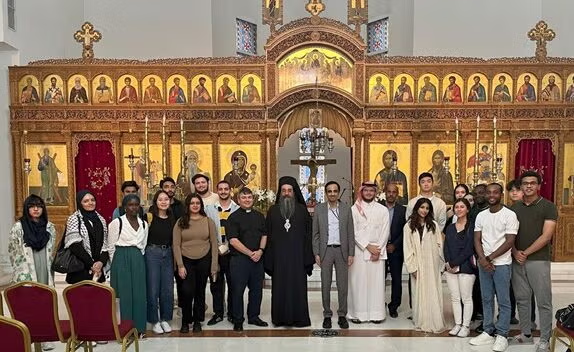
Wilbert (3rd from Left) at the religious complex with his class
For aspiring diplomat Wilbert Fils Pierre-Louis (GU-Q’26), the course, which included a visit to the Religious Complex in Qatar, invited him to explore the intersection of religion and politics. His case study explores the significance of Haitian nationalist leader Charlemagne Péralte, who was killed while resisting the US occupation of Haiti, as a way of debunking persistent misunderstandings about pluralism in Haiti. “As I learned more, I realized this story is not only about war or occupation, it is about defending faith, dignity, and a way of life. I wrote this because the human truths of the story deserve to be clearly told.”
“I continue to use our findings in my classes today,” says Dr. Akinade, who teaches multiple courses on religion at GU-Q. “These case studies truly provide wonderful and new insights for creatively engaging religious diversity in our contemporary world.”
Case Studies by Country and Topic
Religious Dress and Hair Style
- Canada: “Beyond the Veil: A Tale of Rights and Resilience” Kingwell Qianwei Ma, GU-Q’26
- Canada: “Quebec’s Bill 21: Where Pluralism Grows – or Fails” Noor Shadid, GU-Q’24
- France: “Hands Off My Hijab: A Young Activist’s Dilemma,” Bayan Al-Quneibi, GU-Q’26
- France: “Swimming against the Current: The Pennes-Mirabeau Burkini Controversy,” Seynabou Tall, GU-Q’25
- Ghana: “Navigating Faith and Education,” Bonsu Nyame Ishmael, Northwestern Qatar ‘24
- Turkey: “The Veil in Parliament: The Case of Merve Kavakcı” Noha Al-Hamid, GU-Q’24
Sites of Worship
- India: “In the Name of God: The Babri Masjid Controversy,” Kim Z. Chen, GU-Q’26
- Spain: “In the Footsteps of Our Predecessor: The Controversy Surrounding Muslim Prayer in the Mosque-Cathedral of Córdoba,” Jawahir Al-Sulaiti, GU-Q’23
- Switzerland: “Forbidden Spires” Reigna Dukhan, GU-Q’26
Intersection of Religion and Politics
- Haiti: “Charlemagne Péralte and the Struggle for Religious Pluralism in Haiti,” Wilbert Fils Pierre-Louis, GU-Q’26
- India: “Dancing Across Cultures: Love Jihad, Religious Freedom, and Social Media in India,” Muhammad Ramsan Cheerakkolil, HBKU