

At a Crossroads: India’s Iran Policy
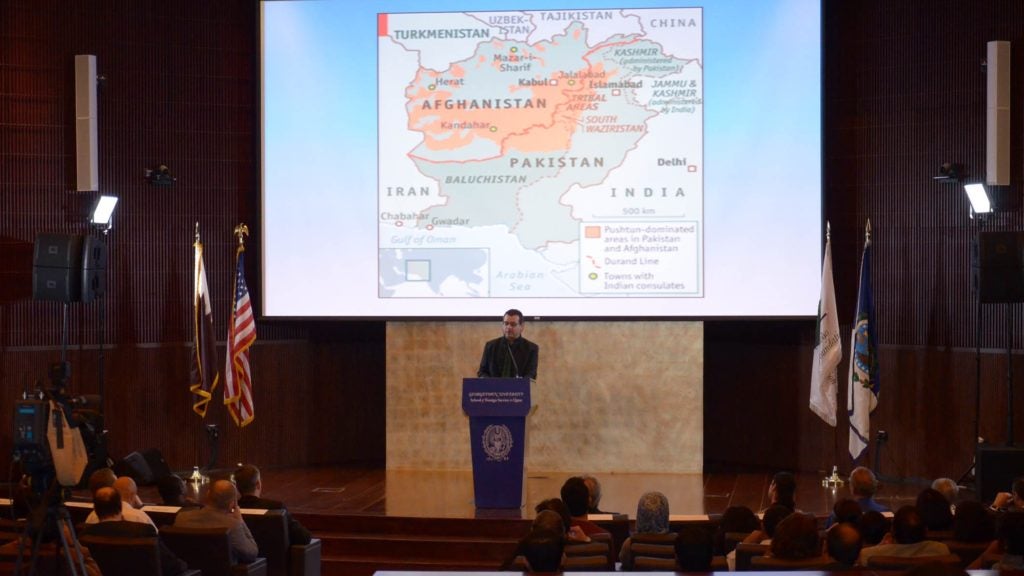
Georgetown University School of Foreign Service in Qatar (SFS-Q) recently hosted Dr. Vijay Prashad at a Faculty Distinguished Lecture titled “India’s Iran Policy: Between US Primacy and Regionalism”. Dr. Prashad, who holds the George and Martha Kellner Chair in South Asian History and Professor of International Studies at Trinity College, Connecticut, USA, is the author of more than fourteen books, as well as being a regular contributor to a variety of international journals and newspapers.
His focus on the topic of India and Iran relations as presented at this distinguished lecture stems from his deep interest in the history of the developing world. His book, The Darker Nations: A People’s History of the Third World (The New Press, paperback 2008), was chosen as the best nonfiction book of 2008 by the Asian American Writers’ Workshop and won the 2009 Muzaffar Ahmad Book Prize. He delves deeper into the big debates surrounding development with an upcoming book titled The Poorer Nations: A Possible History of the Global South (Verso and LeftWord, 2013). Dr. Prashad cited these publications, saying “the trajectory of my research has led me to understanding 20th century development battles as being between North and South, versus the traditional West vs. the ‘Third World’ paradigm.”
He relays the story of the rise of BRICS states, and their search for a new roadmap that differs from the path set forth by the “American road” for development. “There is a duality that is the setup for many countries,” he says. This duality, he expounded in his lecture, is the crossroads in which newly emerging power players find themselves. “These countries operate their foreign policy under the assumption that the United States, though no longer the dominant economic power, will remain the dominant military power. At the same time, these countries are trying to come to terms with the role of regional politics.”
This tussle between two narratives for foreign policy and diplomacy is playing an increasingly important role in the discourse on geopolitics and the developing world. Gerd Nonneman, Dean of Georgetown University’s School of Foreign Service in Qatar, stressed the importance of understanding the significance of the relationship between countries’ regional interests and international relations for these emerging power players. “Recent pivotal shifts in the balance of economic powers have triggered the emergence of competition from newly industrialized economies. The impact of these developing countries will continue to have a significant influence on regional and global affairs.”
Dr. Prashad presented the case of India, and it’s relationship with Iran, as a model of this internal struggle between Western cooperation and regionally-driven policy making. “On the one hand, India is subordinate to the U.S. narrative. But on the other hand, India is drawing together a regional web with Afghanistan, Pakistan, and Iran.” He argued that though international relationships play an important role for Indian foreign policy, domestic political and economic demands do as well. “Iran, despite Western protest, remains an essential part of India’s projections, serving as a potential market for Indian oil. Herein lies the dilemma for India.
Dr. Prashad concludes that “It appears that regionalism is the way forward, but it will be a hard road to get there.” Habits and institutions, he argues remain fixed to the West-centric model. The stakes remain high for all of the players involved, but for India, the road forward remains a political challenge as they remain caught between often competing interests. He quoted a senior Indian government official, who deftly summed up the state of relations with the West, and relations with Iran: “We are between two stools, but we haven’t yet fallen between them.”