

Five Tips For Women Considering Careers in Economics
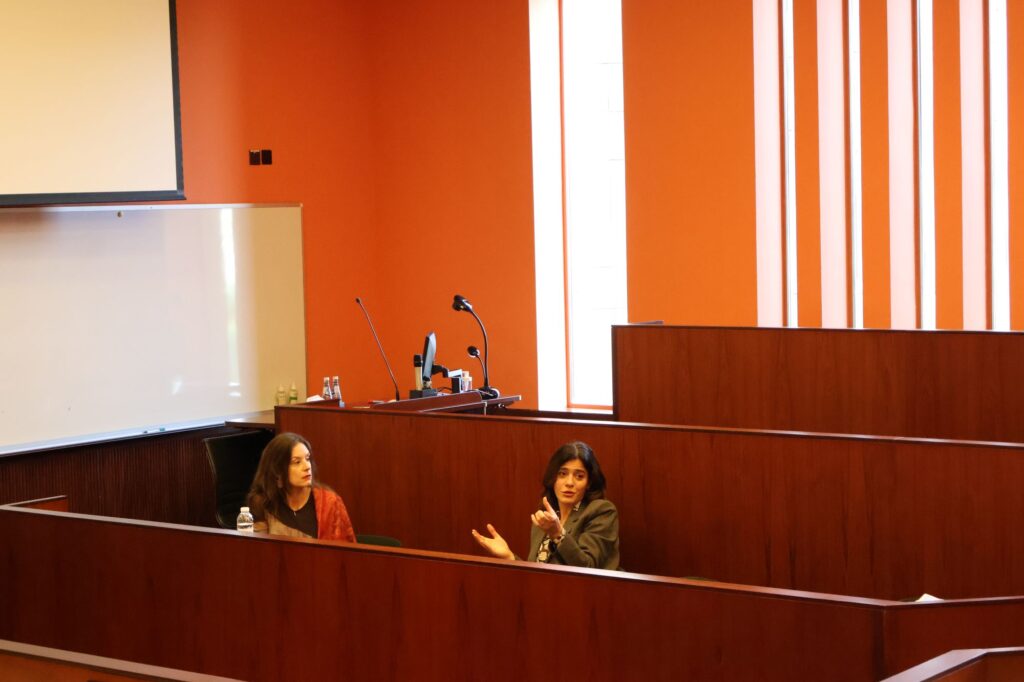
Georgetown University in Qatar (GU-Q) recently hosted a “Women in Economics” session featuring Dr. Lamis Kattan, Assistant Professor of Economics at GU-Q, and Dr. Garance Genicot, Professor of Economics at Georgetown University in Washington, DC. The event was part of a faculty intellectual exchange that brought Dr. Genicot to the Qatar campus as a short-term visiting scholar.
“It’s wonderful to be somewhere where the majority of students in the economics classes are females,” said Dr. Genicot. “Since Qatar has invested so much in development, it presents a golden opportunity for women to be at the table for economic decisions that affect society.”
Drawing on their own nontraditional paths, the two female professors shared five key lessons for women considering advanced degrees and careers in economics.

1. Your path doesn’t have to be linear.
Both professors emphasized that few economists begin with a fixed plan. Dr. Genicot explained that she initially thought she might become a journalist and was drawn to economics as a way to understand society. Encouraged by an undergraduate advisor, she applied to PhD programs and discovered she enjoyed the work. “What I enjoy most is that each research project feels like a new job: new questions, new tools, new collaborators. That constant reinvention keeps the work intellectually exciting.” Dr. Kattan shared that she first considered engineering before choosing economics because of her love of math, later finding her way to a PhD after working in banking. “A PhD is a long-term commitment,” Dr. Genicot noted, “so it’s okay to revisit a PhD track during your Master’s program.”
2. You don’t have to love research to study economics.
“You don’t have to love doing research to be interested in research,” said Dr. Genicot, stressing instead the importance of being “informed consumers of research” and understanding evidence beyond headlines.
3. Confidence matters.
“If you get a bad grade, don’t doubt yourself,” Dr. Genicot advised, noting that women are more likely than men to interpret setbacks as evidence they don’t belong. “For example, a male will get a B and say he is good at math, while a female will get a B and say she is bad at it.”
4. Don’t be deterred by gender imbalances.
“When I am working with others, I work with their brains, and it’s easy to forget about gender,” said Dr. Kattan. While female mentors can make a difference, Dr. Genicot added, “It’s important not to limit yourself. I’ve been lucky to have many great male mentors.”
5. Everyone can contribute to research.
“Don’t think you need to invent a totally new topic,” shared Dr. Kattan. “You can look at an old topic in a new light, especially with the new tools that are coming out all the time.” Dr. Genicot agreed, also highlighting why gender representation matters so much.“Research topics are often chosen based on personal interest, and women have different concerns than men.” This also carries over into the work that institutions do. “When you are the boss, you can decide what matters,” reminded Dr. Genicot.