

Georgetown SFS-Q Hosts IMF’s Qatar Mission Chief for a Distinguished Lecture on Qatar’s Economic Future and Challenges
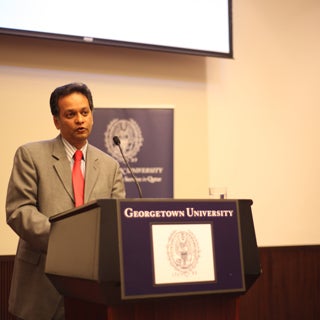
Georgetown University School of Foreign Service in Qatar (SFS-Q) hosted an event as part of its Distinguished Lecture series on Monday.
During the well-attended session, Dr. Ananthakrishnan Prasad, the mission chief for Qatar in the GCC Division of the International Monetary Fund (IMF)’s Middle East and Central Asia Department, led a presentation on Qatar’s vibrant economy, the ingredients that made it one of the fastest growing Middle Eastern economies of the decade, and the challenges.
In his lecture entitled ‘Qatar: Economic Performance, Outlook and Challenges’, Dr. Prasad began by outlining salient facts that make Qatar an interesting study for economists around the world and interspersed his talk with latest insights, data and projections on Qatar.
“Qatar has the third largest reserves of natural gas in the world; …foreign assets (central bank and sovereign wealth fund) stand at an estimated $150bn; 85.9% of government employees are Qataris; and, although over 99% of private sector employees are non-Qataris, unemployment is as low as at 0.5%,” noted Dr. Prasad.
“Together with distribution of wealth among a small national population, this goes a long way to explaining why Qatar is stable and has remained relatively insulated from problems in the global economy and the Arab world,” said Dr. Prasad.
“The mainly hydrocarbon-reliant country has hedged itself against price falls or recessions. Even if demand for LNG dips in one country, Qatar can divert its supplies to someone else,” added Dr. Prasad.
Currently Qatar supplies energy – mainly LNG – to 23 countries through medium to long-term contracts.
Real annual GDP growth has averaged over 18 % since 2006 (compared to 9% for the GCC as a whole), according to Dr, Prasad, who points out the country’s “stellar” economic performance has been spurred by high hydrocarbon prices, but this also led to rising fiscal dependency on hydrocarbon as well as an increase in appetite for capital and current expenditures.
“Fiscal balances are more vulnerable to oil price declines. Qatar’s break-even oil price already stands at $40 per barrel, but this is well below the GCC average. Moreover, like others in the GCC, Qatar has been saving its surpluses,” said the IMF official. The current account balance in 2011 is estimated at about 35% of GDP.
The financial soundness indicators – assets, capital adequacy ratio, return on assets and equity, and non-performing loans – remain favorable, as do the ‘nonfinancial corporates,’ he said.
But while Qatar’s outlook is positive, there are increasing risks, Dr Prasad pointed out: “There remain risks of global tightening of liquidity a slowdown of the global economy, and rising break-even oil prices,” pointed out Dr. Prasad.
Further, 2012 is expected to be the last year for Qatar to witness another strong cycle of real GDP growth, thereafter stabilizing, as the country’s moratorium on new projects come into effect. Yet Dr., Prasad forecast some inflationary pressure beyond 2012, leading to core inflation figures around the 5% mark in the medium term.
The challenge for Qatar, according to Dr. Prasad, was to design a long-term fiscal framework in the absence of an independent monetary framework.
Nations’ policy instruments generally include both fiscal and monetary policies as well as exchange rates. Qatar, however, remains a fixed-exchange economy, which cannot deviate from changing its interest rates policy for that of the Federal Reserve for too long.
“Qatar should have a formal framework of fiscal policy rooted in formal rules… (currently), you have informal rules where budgets are based on assumptions,” said Dr. Prasad.
“A complementary instrument in Qatar’s case would be to also have a macroprudential policy. And finally, developing local debts market is also important. Government debt markets provide reference interest rates at various maturities,” added Dr. Prasad.
The SFS-Q Dean, Professor Gerd Nonneman, who also moderated a subsequent question and answers session, said: “I am both proud and grateful that Dr. Prasad was willing to come and give a Distinguished Lecture at Georgetown on Qatar’s economy and prospects, especially in the midst of his team’s already very full schedule.
“At Georgetown, we have of course a team of economists as well as economics students, but we’re all part of the country’s development, so we feel we all have a stake. It was especially good to see so many in the audience from outside Education City, from the Central Bank and commercial banks, to Silatech and several government and private organizations and companies,” added Dean Nonneman.