

Georgetown SFS-Q Hosts NATO Roundtable
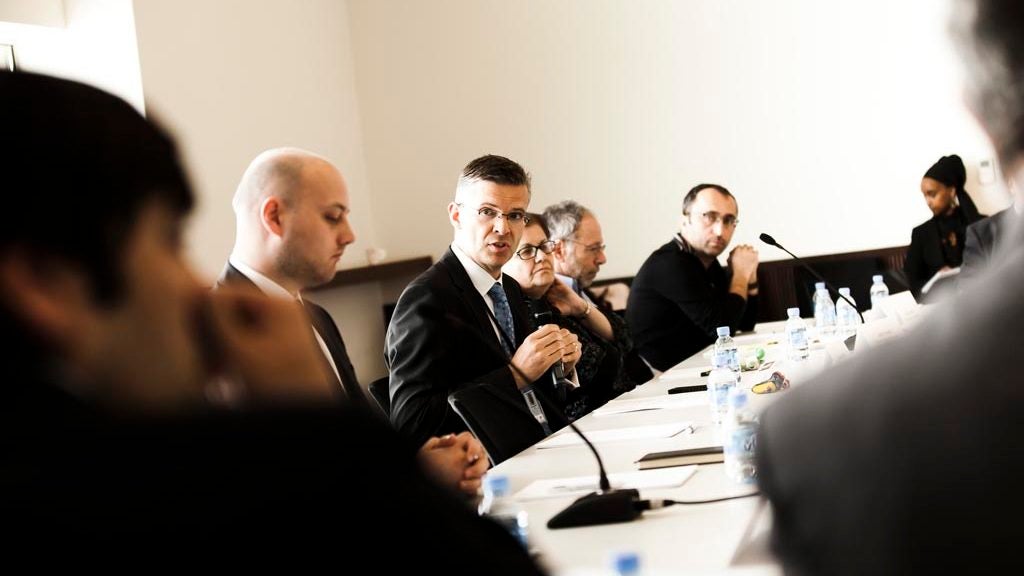
NATO Parliamentarians from thirteen member states attended a roundtable on Security and Stability in the Gulf Region at Georgetown University’s School of Foreign Service in Qatar (SFS-Q). Representing countries including Portugal, Germany and Norway, among others, the NATO Parliamentarians were privy to a nearly two hour question and answer session featuring SFS-Q subject matter experts (SMEs) Amira A. Sonbol, Gary B. Wasserman, Mark Farha, Birol Başkan, and colleagues from Brookings Doha, Director Salman Shaikh, and the Royal United Services Institute in Qatar (RUSIQ), Deputy Director David Roberts. Dr. Kai-Henrik Barth, Assistant Dean for Academic Affairs at SFS-Q, moderated the Q&A Session.
Marit Nybakk, Chair of the Subcommittee on NATO Partnerships and a Norwegian delegate, opened the discussion by citing the importance of briefing the NATO parliament: “We think that it is important that NATO has a parliamentary assembly. We come in contact with people in different ways than our government.”
Tackling the topic of security and stability in the Gulf region, Salman Shaikh began by stating that Gulf monarchies have deflected the Arab Spring through massive social spending. He questioned the sustainability of this approach, arguing that the viability of the current social contract in the Gulf is in need of urgent modernization. According to Shaikh, Qatar is faring better in this respect, as it began the long process of reform in the 1990s. David Roberts of RUSIQ added that there is leeway in the time left for the maintenance of the wealth-sharing social contract in the Gulf, leading to reluctance for reform.
Prof. Gary B. Wasserman contributed the American dimension by citing “the shift in the United States from energy dependence on the Gulf region to energy dependence on the North American and South American continent.” The ramifications of increased energy exports to India and China for the security of the Gulf region was considered by many members of the Q&A session, with a consensus that there is a shift in strategic focus, from the point of view of the United States, away from the Middle East and towards the Far East.
Prof. Birol Başkan reaffirmed this view by arguing that the reliability of the U.S. as a regional bulwark is waning. In this scenario, concluded Başkan, China, India and Turkey could play a greater role in the securitization of the energy-rich Gulf region.
David Crausby, a NATO Parliamentarian from the United Kingdom, wanted to understand the effect of a potential U.S. or Israeli strike on Iran. Salman Shaikh of Brookings Doha said that the threshold for U.S. intervention has always been the acquisition of a nuclear weapon by Iran. This threshold, he continued, has shifted to the capability side, increasingly resembling the Israeli stance. Such a move, according to Shaikh, could spark a wide regional conflict and inflict severe economic consequences.
Prof. Gary B. Wasserman confirmed that Obama is unlikely to risk a strike on Iran in a domestic election year. Prof. Sonbol added that an attack on Iran would be very negative at this stage, radicalizing the Middle East and having little to no support from the Arab people, bracketing the stances of their regimes.
José Lello, a NATO Parliamentarian from Portugal inquired into Qatar’s provisional plans for the closing of the Strait of Hormuz and the rationale behind the escalatory rhetoric emerging from the region. In response, Prof. Farha warned that loose talk of war could open the door for provocations and secret covert operations. He thought that the fall-out from a strike on Iran, even if its closure of the Strait of Hormuz were ineffectual, would be sufficiently felt through elevated insurance costs for shipping freights.
Prof. Sonbol qualified the discussion on the threat of an Iranian first strike. “Iran does not have a history of aggression towards its neighbors.” With regard to perceptions on the Arab Street, Sonbol put forth that Western reticence to allow the development of nuclear technology in the East is perceived as a replay of dependencia in the Arab world. One speaker gauged Iranian intentions towards the development of nuclear capabilities as related to defense purposes.
Dr. Kai-Henrik Barth, also an expert on Nuclear Non-Proliferation, graciously deferred all questions to his colleagues while presiding over the event, and closed this lively and engaging session by thanking all interlocutors on behalf of Georgetown University’s School of Foreign Service in Qatar.