

How Musician Jemimah Golo is Centering African Rhythms on Stage and in the SFS Classroom
In honor of Black History Month, we celebrate the many contributions of our Black students, alumni, faculty, and staff to our community and society, and recognize the broad range of teaching, scholarship, and advocacy at Georgetown aimed at advancing Black heritage and history.

When senior Jemimah Golo walked onto the stage to interview global music phenomenon Saint Levant during his recent visit to Georgetown University in Qatar (GU-Q), she felt completely at home. She’d stood under bright lights many times before, but this moment was different. Instead of performing, she was bringing her scholarship and her artistry together in one rare, electric conversation.
A Scholar Who Thinks in Sound
A Culture and Politics major concentrating in political ethnomusicology, Jemimah studies questions few think to ask: What can sound teach us about power, identity, and belonging? Her work examines how African sound traditions, from talking drums to Afrofusion, carry political meaning. “Sound has been erased from political thought in many contexts,” she explains. “I’m studying how we lost that—and how much we can learn from bringing it back.”
She pairs this with minors in Africana Studies and French, weaving together cultures and histories that shape her identity as a Nigerian student in the Middle East.
From Open Mics to International Stages with Acclaimed Musicians
Through all her studies, music has been her compass and source of inspiration. Growing up in Lagos and Kaduna, Nigerian rhythms surrounded her, but moving abroad deepened her connection to them. “When I moved to Qatar, I started intentionally listening to African music,” she says. “It reminded me of home. Of myself.”
At GU-Q, she performs at Cultural Nights and student festivals and records original music using equipment at the university’s Innovation Lab. She has performed across Doha and in Washington, DC during her semester studying abroad. Her Afrofusion style blended with R&B, rap, and hip-hop, reflects her willingness to experiment. “People tell me all my songs sound different,” she laughs. “I take that as a compliment.”
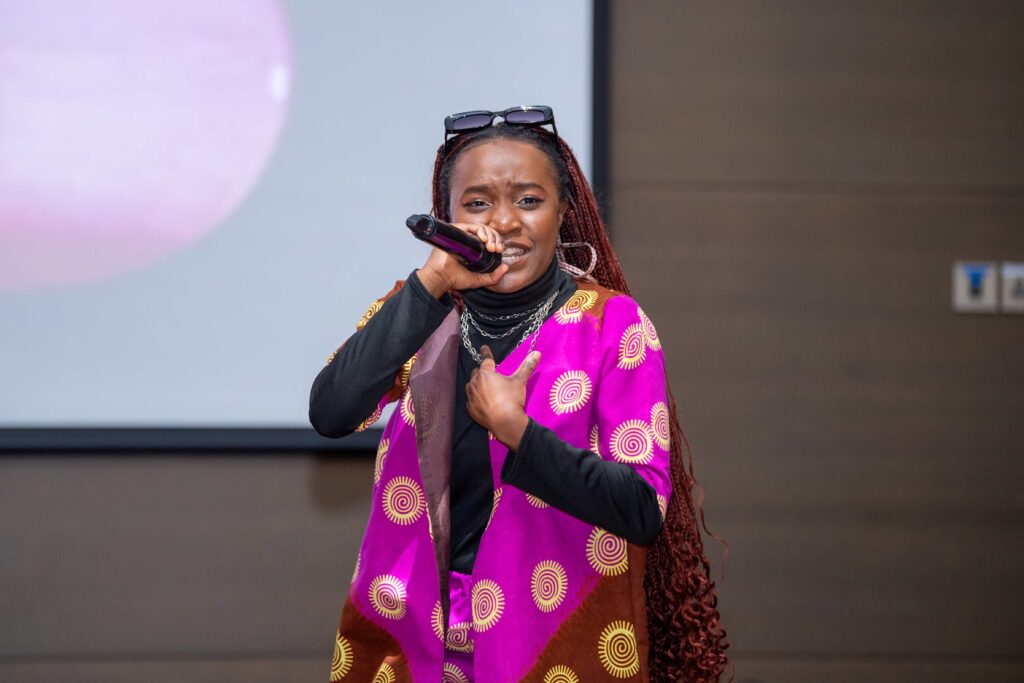
Performing at American School of Doha Black Excellence Scholarship Ball 2025
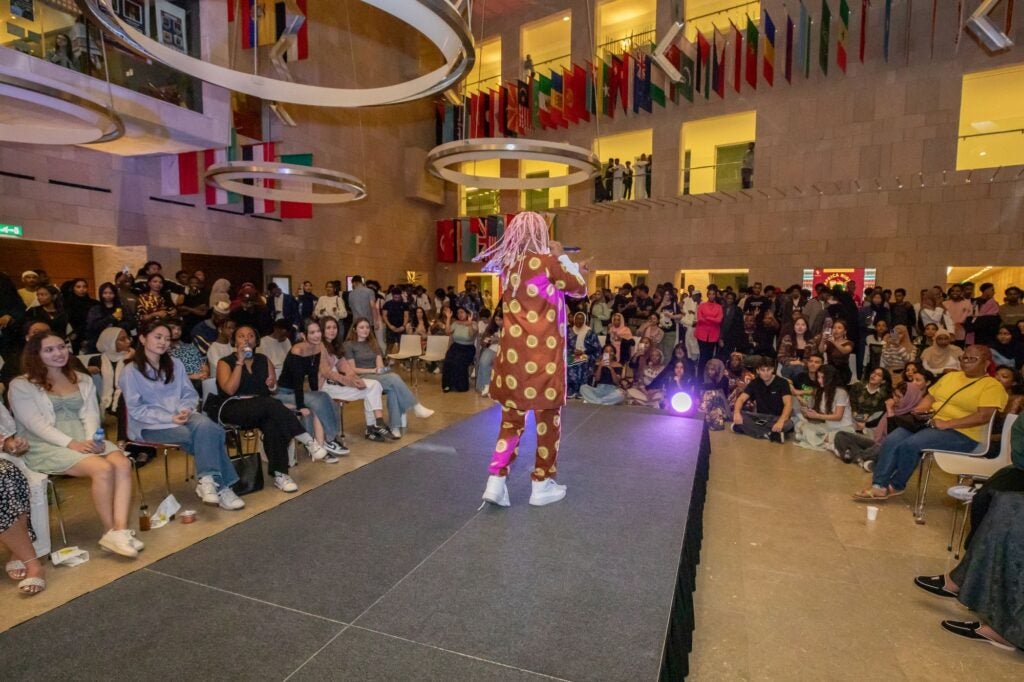
Performing at GU-Q Africa Night
When GU-Q announced that Saint Levant would visit campus, Jemimah immediately applied to interview him, drawing connections between his themes of identity and displacement and her own research. On stage, she guided the conversation to artistry, purpose, and global storytelling.
“He’s only 25,” she said afterward, “and what he’s done in such a short time is inspiring. It made me feel like the things I want to do are possible.”
His reflections on multilingual identity resonated deeply. Her journey from Nigeria to South Africa’s African Leadership Academy, to GU-Q, to Washington, DC, and Ghana during winter break for a research grant, has sharpened her purpose. “The more places I’ve been, the more achievable my goals feel,” she says.
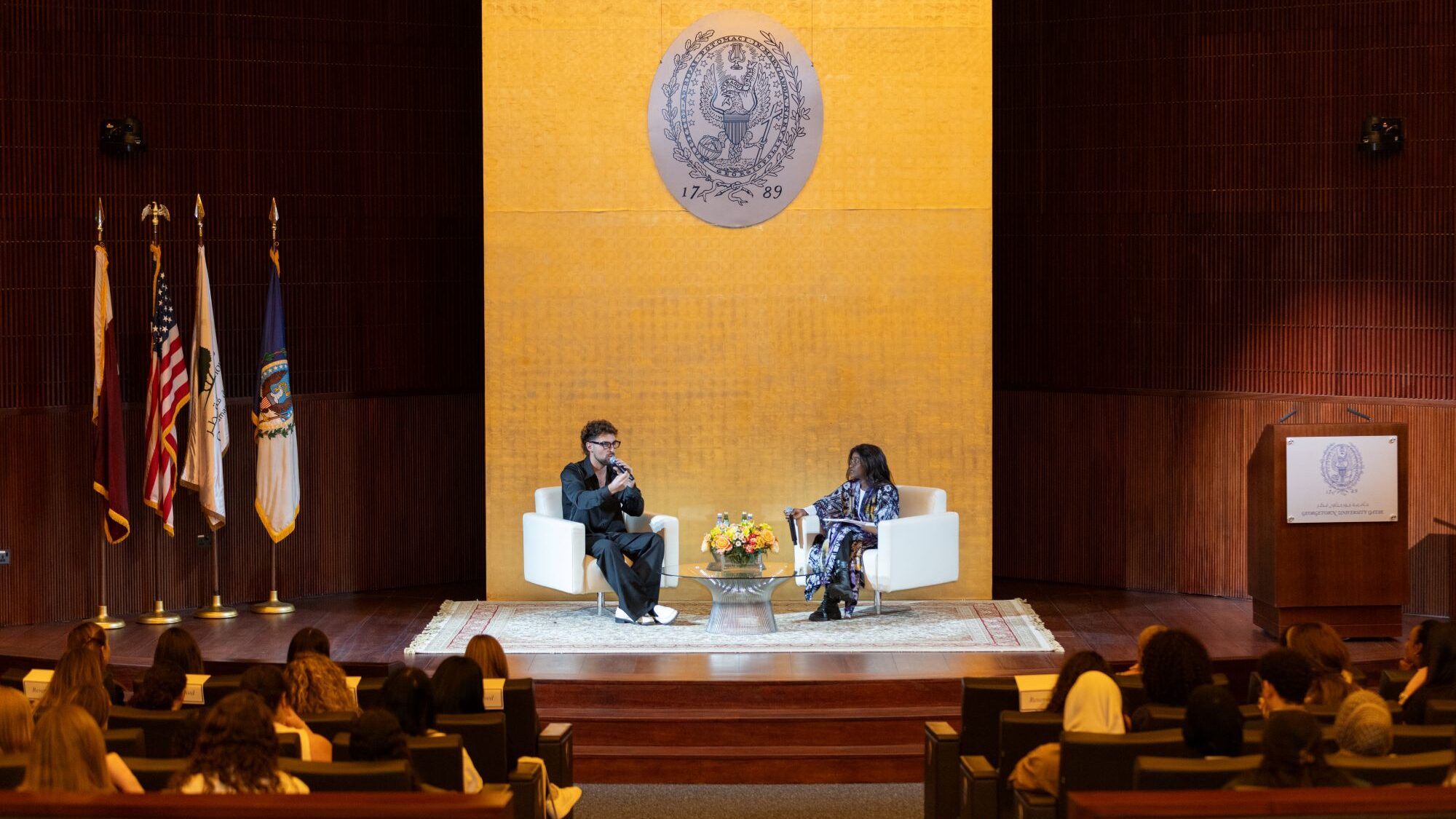
Interviewing Saint Levant at GU-Q
What Georgetown Made Possible
A defining moment was her internship at Mavin Records. “I had sound engineers and music producers listen to my music and tell me ‘this is good, you should continue.’” At GU-Q, seminar courses, the Africana Studies minor, mentorship from Dr. Lynda Iroulo, and the Innovation Lab helped her develop her research and sound. “I don’t think I would have found this version of myself anywhere else,” she said.

Interviewing Saint Levant became another milestone—especially when he told her he liked her song “Kolo,” sending the crowd into cheers.
Jemimah hopes to continue both scholarship and music after graduation, possibly pursuing graduate studies in global studies, ethnomusicology or Africana studies while releasing her first album.
“At this point, I might as well call it the GU-Q album,” she jokes.