

Scholars from Around the Region Gather to Discuss the Arab Spring: One Year Later
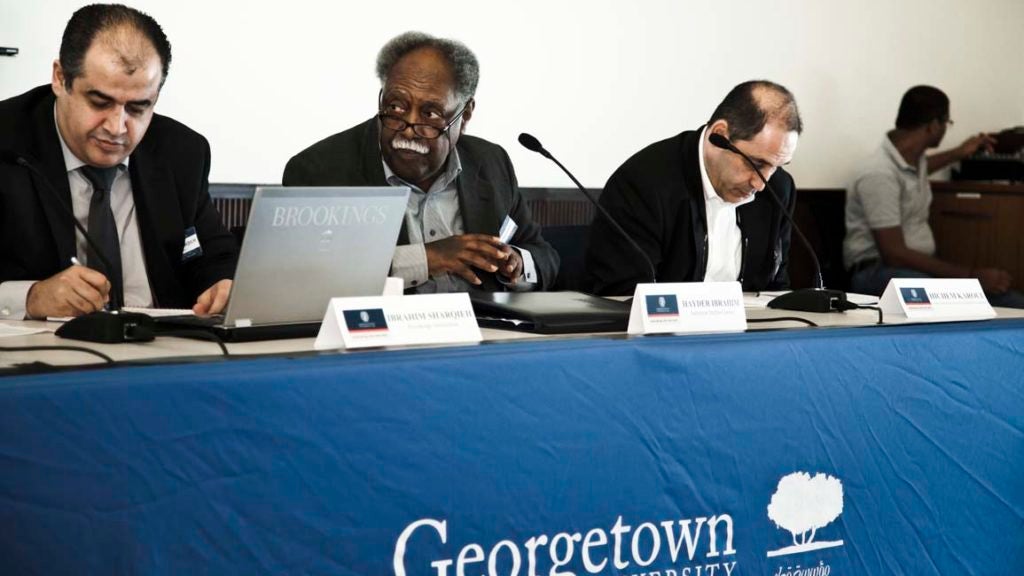
Students and professors from around the region gathered at Georgetown University’s School of Foreign Service (SFS-Q) to recount and analyze the aftermath of the Arab Spring during a one-day workshop, which took place on the university campus yesterday.
The workshop, part of the Arab and Regional Studies Program (CARS) at SFS-Q and which was organized in collaboration with the Center for International and Regional Studies (CIRS), allowed students and scholars from various disciplines to discuss the effects of the widespread revolution which toppled four Arab dictators and led to widespread rebellions across the region.
Beyond the strictly political domain, topics under discussion included Cultural Dimensions and Values; Language and Culture; Class, Religion, and Gender; and The Future Ahead.
Lamia Adi, a Georgetown University student as well as a Class, Religion, and Gender panelist peppered her discussion with personal tales of Syria. She praised the subjects stating, ““The lecturers shed light on specific topics, like the use of language on signs and banners throughout the revolution. It was really interesting to see how both humor and satire were weaved into the messages. I also enjoyed learning about how important symbols are in religion, for example, the growing of a beard and what it represents.”
Yehia Mohamed, a panelist on the Language and Culture discussion, is an assistant professor at SFS-Q and has resided in Qatar for five years. The lecturer explained how a new language was born from the revolution of the Arab Spring. Commenting on the topics, “Every day we see political analysis of the Arab Spring on television, in journals, in newspapers; the workshop gave people a chance to discuss other aspects of the revolution, for example culture.”
Lena Zahir, a student studying International Politics, further supported the lecturer’s statement: “It’s great to see how interested the scholars are in the people of the revolution – it’s not just about the politics.”
The panelists ranged from undergraduates at SFS-Q to professors and scholars from both within Qatar as well as around the region.
The workshop was a great opportunity for academics from around the world to meet and share ideas; a sentiment which was reiterated by Robert Crane, Director of Contemporary Muslim Societies center in Faculty of Islamic studies – Qatar: “The scholars brought here together are well informed and diverse; it is a community of experts. Very impressive.”
“The workshop is very timely. A year of experience to evaluate, and we’re still beginning to figure it out. Hopefully we’ll be able to forecast the future,” he added.